
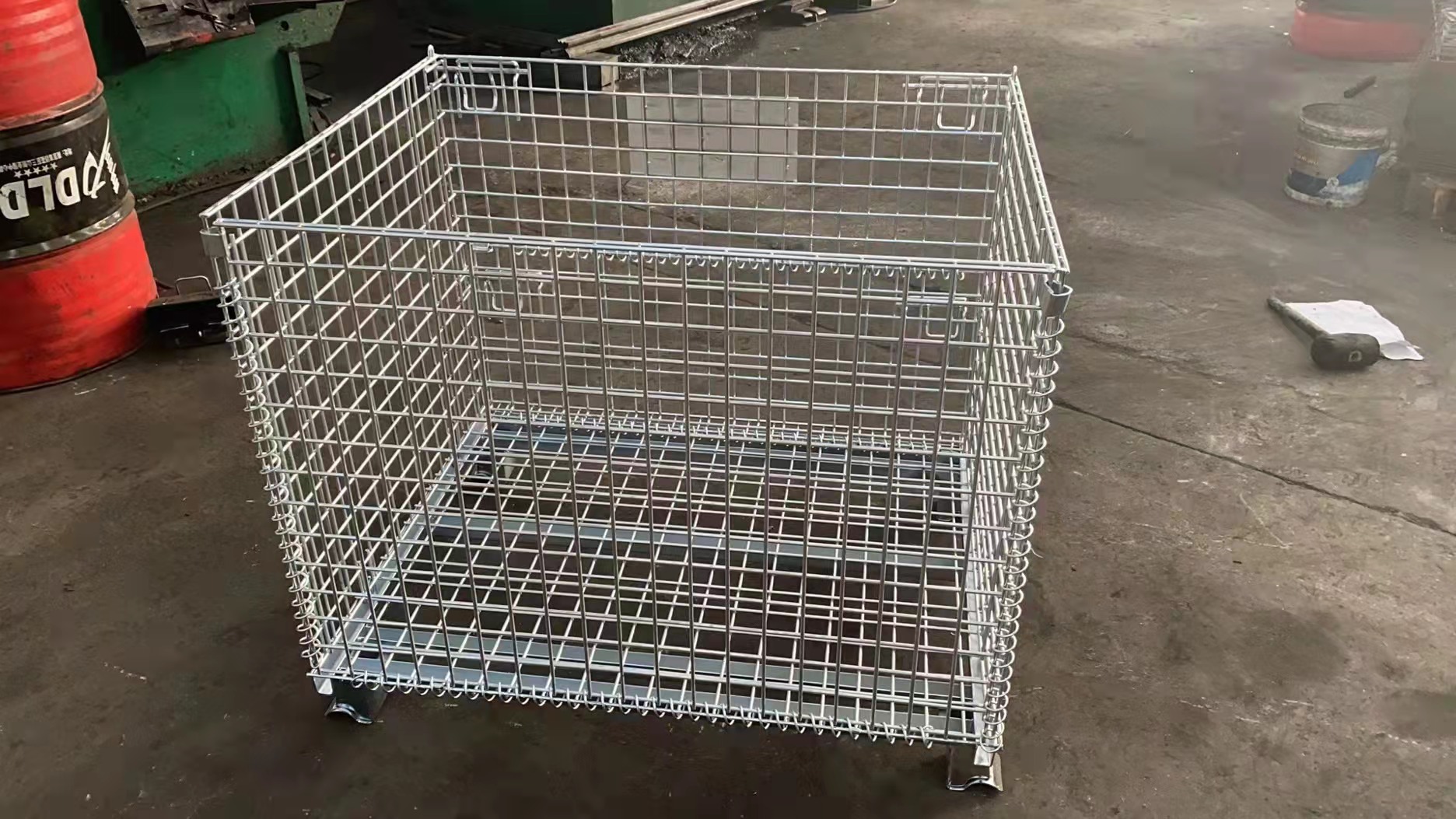
A warehouse cage, also called a warehouse cage, butterfly cage, or foldable wire mesh cage, has a fixed storage capacity, stacks neatly, stores conveniently, and makes stocktaking easy, while raising warehouse space utilization. It transports easily and is reusable, cutting the labor and packaging costs of storage operators. It works not only on production floors but also as display, promotion, and storage in supermarkets. An upgraded cage can sit on racking or a production line and can be stacked; wheeled units turn over quickly around the shop floor, and cages with a PVC or steel panel stop small parts from falling through. Main features: 1. Steel hardened by cold rolling and welded gives high strength and a large load capacity. 2. Uniform specs and fixed capacity give convenient storage and easy stocktaking. 3. The galvanized surface looks clean and lasts relatively long. 4. It pairs with shipping containers to raise space utilization. 5. Full cages stack four layers high for three-dimensional storage. 7. It works efficiently with forklifts, pallet trucks, lifts, and cranes. 8. The foldable structure keeps recycling costs low. 9. Wheels can be added to the bottom for easy internal turnover. The American-style warehouse cage (also called European-style) differs from the standard one in its feet: the feet are made of steel wire, usually stamped from steel plate. In materials, the cage mainly uses wire drawn from high-carbon wire rod, usually at wire diameters of 5 mm, 6 mm, and 6.4 mm; mesh spacing is usually 50x100, 100x100, and 50x50. The bottom is welded from U-section steel rolled by a cold-rolled strip mill, and the four bottom corners are stamped in one stamping operation.